
UPDATE: Report to be discussed at Camden’s Housing Scrutiny Committee 25.02.25, 6.30pm Camden Town Hall
See details here
.
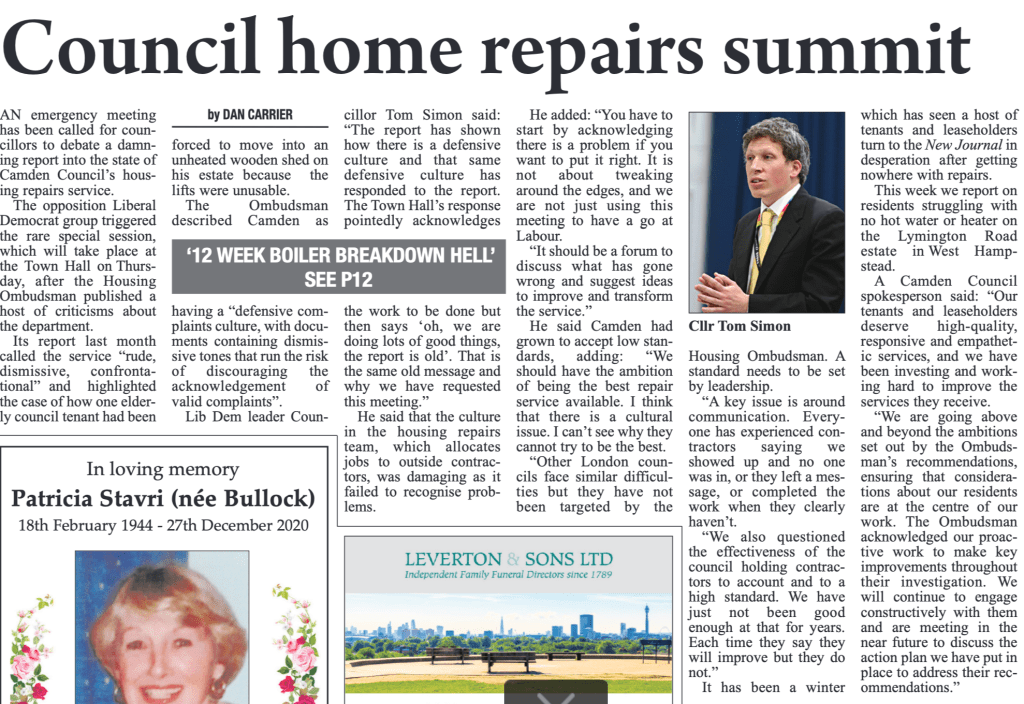
The Housing Ombudsman has issued a report on Camden Council which you can read here:
The document reviews the findings of a special investigation conducted by the Housing Ombudsman into systemic failings within Camden Council’s housing services. The investigation was initiated following a concerning increase in severe maladministration findings against the council between April 2023 and October 2023, particularly in repairs and complaint handling.
Key Findings:
- Complaint Handling: A 90% maladministration rate was found in cases involving complaint handling, significantly higher than the national average. The investigation identified serious flaws in Camden’s complaint handling procedures, including:
- Failure to recognise and log complaints: Despite claiming to adopt a plain English definition of a complaint, the council routinely failed to identify and register legitimate complaints, often dismissing them as ‘business as usual’ enquiries. This was evidenced by over 800 such requests annually, with no formal logging or analysis of their nature. This raises concerns about the council’s commitment to acknowledging and addressing resident concerns.
- Delays in acknowledging and responding to complaints: The investigation found that the council consistently failed to meet its own timeframes for acknowledging and responding to complaints, often leaving residents waiting months for a resolution. Internal emails revealed a dismissive and defensive culture within the complaints team, with phrases like “filtering out cases which are not regarded as a formal complaint” highlighting a reluctance to engage with resident concerns. This suggests a systemic disregard for resident feedback and a lack of accountability within the complaints handling process.
- Inadequate responses: Complaint responses often lacked detail, failed to address all points raised, and did not offer adequate remedies. The frequent use of the phrase “sorry you felt the need to complain” further indicated a lack of genuine empathy and understanding of resident experiences.
- Failure to complete agreed actions: Even when complaints were upheld and actions promised, the council frequently failed to follow through, leading to further delays and frustration for residents.
- Disrepair: A 90% maladministration rate was found in cases involving repairs, indicating serious failings in the council’s ability to maintain its properties to an acceptable standard. Key issues identified included:
- General and communal repairs: The investigation found that the council often lacked adequate records of repairs or failed to review existing records, leading to incorrect decisions and delays in addressing repairs. This was exemplified in Case 202208128, where bathroom repairs were refused due to the council’s inaccurate record of the void defects period. Similarly, Case 202115129 demonstrates the council’s failure to maintain buildings in a reasonable state of repair, causing significant distress and inconvenience to residents.
- Leaks, damp, and mould: The investigation revealed a pattern of inaction and ineffective responses to reports of leaks, damp, and mould. In Case 202211999, at least seven contractor visits were conducted without addressing the root cause of the issue. In Case 202232069, the same ineffective repair method was repeated six times before a proper survey was considered. This suggests a reactive approach to repairs, focusing on temporary fixes rather than addressing underlying problems.
- Poor communication and follow-up: The council consistently failed to communicate effectively with residents about the progress of repairs, leading to uncertainty and a lack of trust. This is highlighted in Case 202124650, where repairs for damp and mould took almost three years due to cancelled work orders, delayed actions, and a lack of proactive communication.
- Vulnerable Residents: The investigation found that the council often failed to adequately consider the needs of vulnerable residents. Reasonable adjustments were not consistently made, and communication barriers were not addressed, as seen in Case 202205534, where a deaf resident’s request for a BSL interpreter was delayed for four months. Furthermore, the council’s record-keeping regarding vulnerable residents was often inaccurate and incomplete, as demonstrated in Case 202204295, where a resident’s cancer diagnosis was not recorded, leading to a dismissive response to their concerns about smoke inhalation.
Recommendations:
The Housing Ombudsman has issued a series of recommendations to address the identified failings, including:
Complaint Handling:
- Implement a clear and consistent process for identifying and logging all complaints.
- Review template letters and remove inappropriate language.
- Improve communication with residents throughout the complaint process.
- Ensure all agreed actions are completed promptly and monitor progress.
Disrepair:
- Improve record keeping and ensure repairs records are accurate and up-to-date.
- Implement a proactive approach to identifying and addressing recurring issues.
- Ensure all repairs are completed to a satisfactory standard and follow up with residents.
Vulnerable Residents:
- Develop a clear policy on identifying and supporting vulnerable residents.
- Ensure reasonable adjustments are made and communication barriers are addressed.
- Provide comprehensive training to staff on the needs of vulnerable residents.
Conclusion:
The Housing Ombudsman’s investigation paints a concerning picture of systemic failings within Camden Council’s housing services. The high maladministration rates and the recurring themes identified suggest a deeply embedded culture of dismissiveness, inaction, and poor communication. It is crucial that Camden Council takes immediate and comprehensive action to address the recommendations set out in this report to ensure that residents have access to safe, well-maintained housing and a fair and effective complaints process. The council’s stated commitment to improvement must be translated into tangible and lasting changes to rebuild trust with its residents.
Press:
letters to the CNJ
 Housing Rebellion Camden